What is the true state of leadership in today’s workplaces? We didn’t want guesses; we wanted data.
A recent public survey by the SIA Foundation measured leadership impact across diverse organisations. The findings, drawn from a broad cross-section of employees, paint a stark and universally relevant picture.
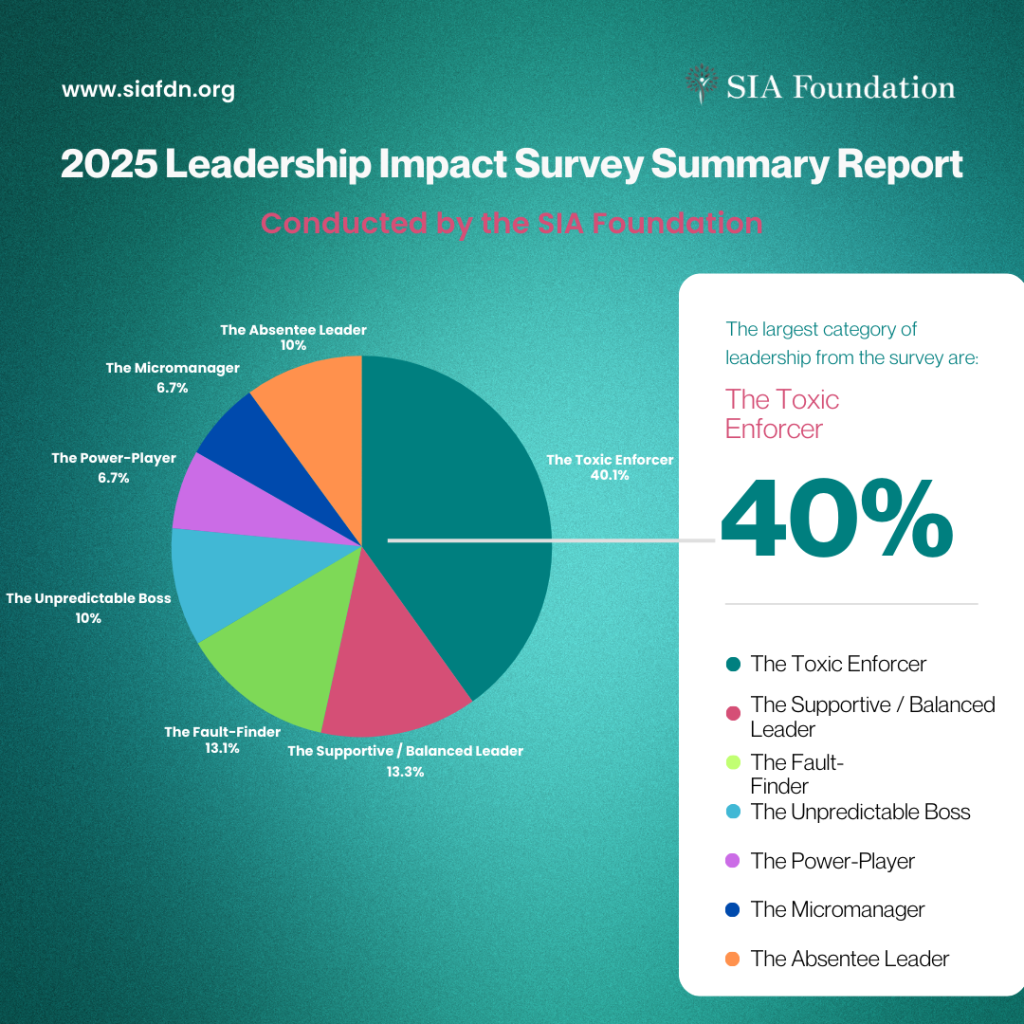
One statistic stands as a critical industry warning: 40% of respondents describe their leader in terms that indicate a demoralising and unsafe environment.
This isn’t about a single company’s culture. This is a systemic insight. It reveals the profound gap between the supportive, accountable leadership that drives performance and the reality many experience daily.
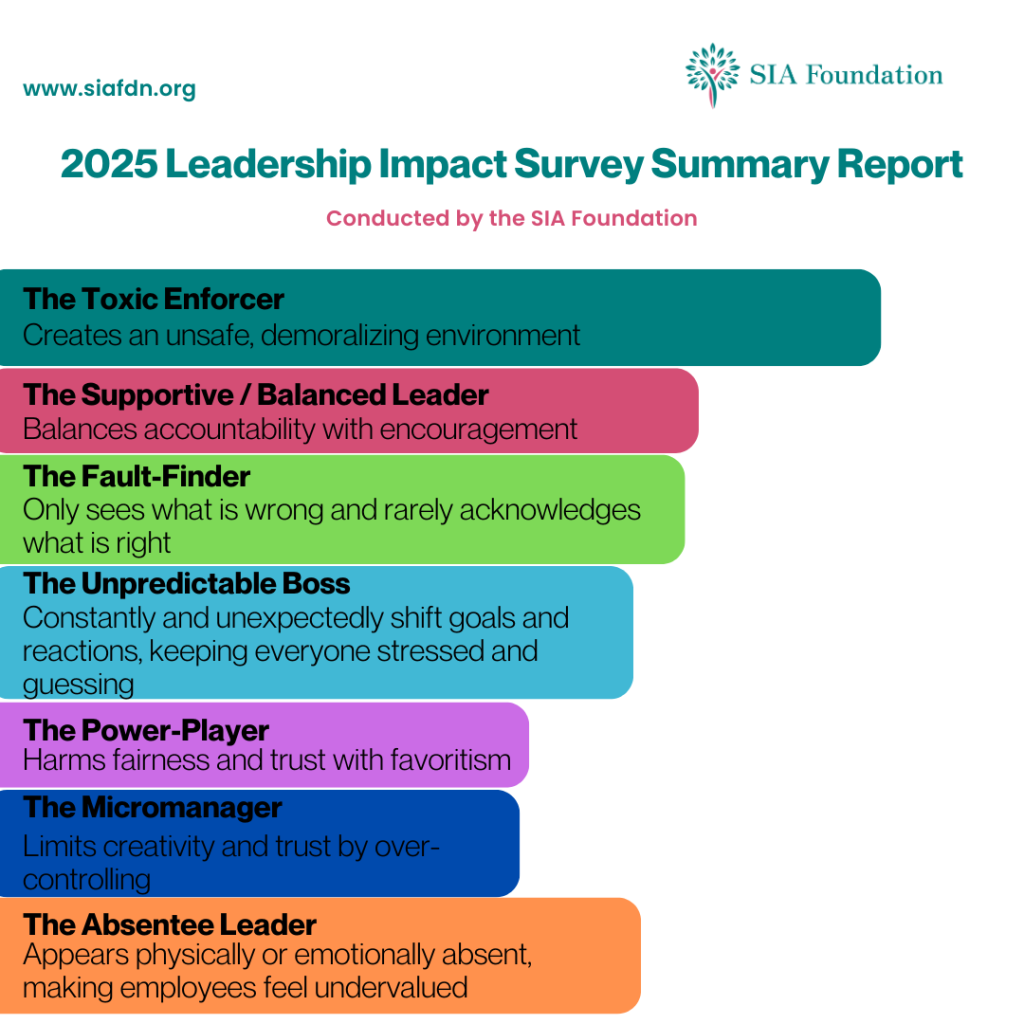
Spectrum of Leadership Archetypes & Their Organisational Impact
Below is the break down the full spectrum of leadership archetypes this data uncovered, from the destructive “Toxic Enforcer” to the highly effective “Balanced Leader” and the tangible business outcomes tied to each.
- The Toxic Enforcer – Primary Behaviour: Fear-driven authority, punitive management.
Impact on Organisation:
- Creates unsafe, demoralizing work environments
- High employee turnover
- Reduced innovation and trust
- The Supportive & Balanced Leader – Primary Behaviour: Blends accountability with empathy.
Impact on Organisation:
- Builds high trust and motivation
- Improves team performance and collaboration
- Model leadership standard in healthy cultures
- The Fault-Finder – Primary Behaviour: Hyper-focus on what is wrong; rarely affirms successes.
Impact on Organisation:
- Low confidence among employees
- Stifles creativity and initiative
- Creates a culture of avoidance rather than improvement
- The Unpredictable Boss – Primary Behaviour: Sudden shifts in priorities, tone, and expectations.
Impact on Organisation:
- Heightened anxiety and uncertainty
- Decreased productivity due to unclear direction
- Team stays in “reactive mode”
- The Power-Player – Primary Behaviour: Favors certain individuals; creates informal “inner circles”.
Impact on Organisation:
- Weakens fairness and neutrality
- Reduces meritocracy
- Damages team cohesion
- The Micromanager – Primary Behaviour: Over-controlling and intrusive task supervision.
Impact on Organisation:
- Limits creativity and ownership
- Slows down workflow
- Employees feel distrusted
- The Absentee Leader – Primary Behaviour: Emotionally or physically unavailable.
Impact on Organisation:
- Employees feel undervalued and directionless
- Weak accountability
- Decision bottlenecks
Recommendations
- MandatoryLeadership Trainings and webinars: Focus on emotional intelligence, giving constructive feedback, and recognizing team contributions.
- Workplace Mental Health Assessment: Train leaders to identify signs of stress and promote well-being resources. Where they can
- Launch a 360-degree feedback program every quarter. Use anonymous surveys to get input on every leader from their own team, their peers, and their own manager. Do this every year.
- Create a structured “Role Model” recognition program where employees nominate and vote for leaders who best demonstrate supportive coaching behaviors, and celebrate the winners publicly.
- Establish a formal risk management process and require quarterly feedback from employees on workload, deadlines, and deliverables.
Recommended Resources for Managing Workplace Mental Health
- Quarterly pulse surveys using questions from NAMI or Culture Amp to track psychological safety and key stressors.
- Lead with Strategy by adopting the ISO 45003 framework as the guiding principle to a “strategic risk and performance imperative.
- Use an annual benchmark, e.g., Mind Forward Alliance and CCLA Benchmark, for Mental Health external comparison.